







“Others are gone when they are gone; when everything has gone away, just you are close to me.” — Oktay Rifat
Naked bodies, silent landscapes, and the nearness of longing.
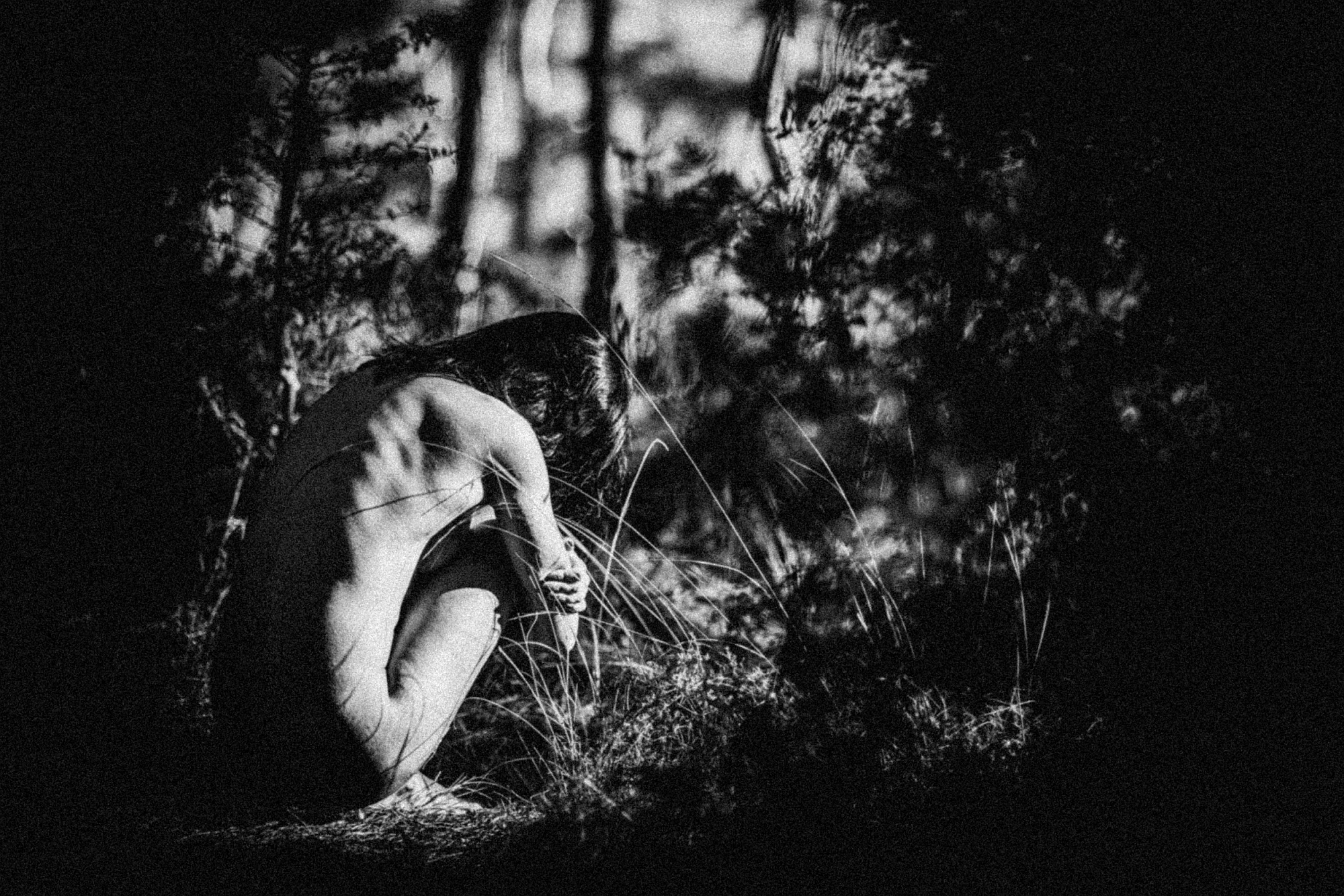
This sub-series emerged from a time of enforced distance—not as a document of isolation, but as a return to images made over many years that suddenly spoke differently. When the world retreated indoors, these photographs of bodies on empty coastlines, among bare branches and sea-worn rocks, became a meditation on what remains close when everything else withdraws.
The visual language draws on a long tradition of the solitary figure in landscape. Caspar David Friedrich’s Rückenfigur—the figure seen from behind, facing the immensity of nature—finds echo here. But where Friedrich’s wanderers stand upright before mountains and fog, contemplating the sublime, these bodies fold into the shoreline, curl on rocks, sink into shallows. They do not confront nature; they yield to it. The romantic sublime gives way to something more elemental: not awe, but absorption.
Bill Brandt’s coastal nudes of the 1950s, made on the rocky beaches of Normandy and Sussex, provide another point of reference. Brandt transformed bodies into landforms—hips becoming boulders, spines becoming cliffs. This series shares that instinct to dissolve the boundary between flesh and stone, but the tone differs. Where Brandt’s images carry a monumental, almost surrealist strangeness, these photographs remain intimate, tender, suffused with the particular melancholy of distance.
The images are rendered in high-contrast black-and-white with soft vignettes that recall analog film—edges darkening as if memory itself were fading at the periphery. This technical choice is not nostalgia but intention: the vignette draws the eye inward, toward the figure, while the world recedes. Figures appear small against the sea, balanced on stones, half-submerged in tide pools. They do not dominate the landscape; they belong to it. This is not the body as subject but the body as element: as present and as silent as rock, water, wind.
The title comes from Turkish poet Oktay Rifat, whose lines capture the paradox at the heart of the work: that absence can sharpen presence, that distance can clarify what is near. These photographs do not mourn isolation—they trace the quiet closeness that persists beneath it. In the space between the body and the sea, something remains that cannot be withdrawn.